Bosnia's Youth Rewrite the Rules of Conflict With a Board Game Built for Peace
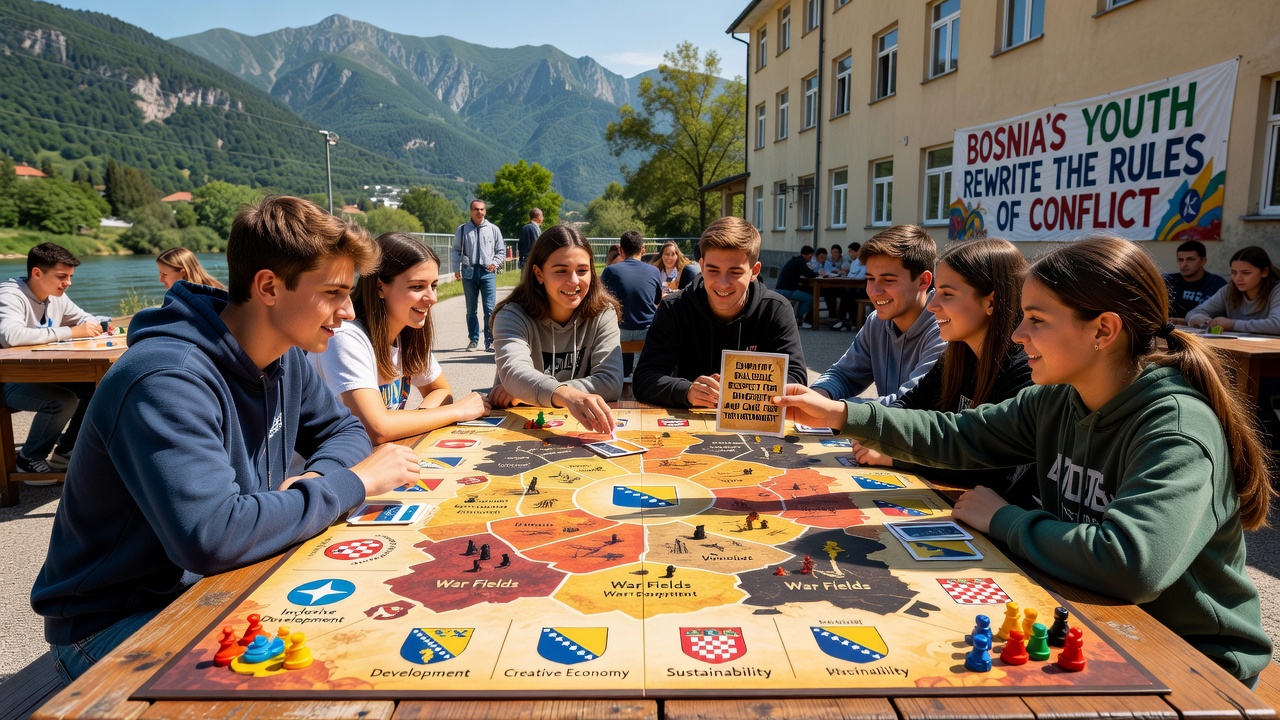
In Foča, a small town in eastern Bosnia and Herzegovina where the Drina river cuts through mountains that once concealed the worst atrocities of a 1990s war, a generation of young people is finding a new kind of common ground - not on a football pitch or a basketball court, but around a board game designed to teach what three decades of uneasy coexistence have struggled to deliver. The game is called Odyssey of Peace, developed by UNFPA, the United Nations Population Fund, with a simple but ambitious purpose: to make peace feel like something young people build together, not something handed down to them by adults who couldn't manage it themselves.
The backdrop matters. Bosnia and Herzegovina technically ended its war in 1995, but the social architecture of division has proven far more durable than any ceasefire. Bosniak, Croat and Serb students frequently attend separate schools - sometimes the same building, different entrances - absorbing conflicting versions of a history they all share. Sport has occasionally bridged those gaps, the way a local football derby or a shared cheer for a national team can momentarily dissolve ethnic lines, much as community leagues in fragmented societies - from the georgia league 4 basketball competition to grassroots football across the Western Balkans - sometimes do more for social cohesion than any policy paper. Odyssey of Peace is working in that same territory, using structured play as a vehicle for something larger.
Shaped by over 1,500 students and teachers from nearly 60 schools across the country - communities once separated by active front lines - the game puts each player in charge of a district with the goal of building a community. Progress is measured in 'crests' earned through initiatives covering inclusive development, creative economy and sustainability. But the board also contains 'war fields': landing on one stops the entire game, regardless of how much any individual player has accumulated. "The outbreak of war is a shared failure," said Darko Samardžić, a 16-year-old Serb student from East Sarajevo, articulating the game's bluntest lesson with the kind of clarity that tends to elude adults in formal political settings.
When the Game Stops, Everyone Loses
The mechanics are deliberate and psychologically sharp. The only way to resume play after hitting a war field is to deploy what the game calls the Armies of Peace - empathy, dialogue, respect for diversity, care for the environment. These are not abstract virtues in the context of a country where mass graves were still being identified as recently as the last decade. They are named responses to named failures. There also comes a moment, built into the structure of every session, when a player from one ethnic community must help another avoid a war field entirely. A Serb passing a card to a Bosniak, a Croat guiding a Serb peer forward. "Through this game, I realized that peace starts with ourselves," said Ana Ćurak, 16, from Vitez. "But it is impossible to maintain it without working together with others."
Built by Young People, Adopted by Schools
The game's design process was itself an act of inclusion. Students and teachers from across the country contributed to its development, giving it a credibility with its audience that a top-down curriculum insert rarely achieves. Tuzla Canton became the first region in Bosnia and Herzegovina to formally integrate Odyssey of Peace into its education system, with all 124 of its schools now using it in classrooms. "This is not a game where we compete to see who is better," said Dalija Malak, from Tuzla. "It teaches us how to be better to each other." The 'people cards' awarded for fair leadership feature real figures from local communities - neighbours, teachers, activists - grounding the game's values in recognizable, living examples rather than historical abstractions.
A Small Country Watching Its Next Generation Closely
Odyssey of Peace is implemented under the regional Youth for Inclusion, Equality and Trust project and the Moving Us Closer project, supported by the United Nations Secretary-General's Peacebuilding Fund and funded by the Government of Italy. Its expansion beyond Tuzla Canton will be the real measure of whether it can shift something structural. Imrah Poško, 18, from Mostar - a city that famously rebuilt its bridge after the war but has been slower to rebuild trust between its communities - put it plainly: "Peace is not a final state, but a process in which we learn to listen, understand and build trust with one another." From the Bosnian Podrinje canton, still carrying some of the deepest war wounds in the country, 13-year-old Arifa Mehić offered her generation's collective ask: "Young people want a future free from divisions, fear and hatred." In a country that has been held together by international frameworks rather than internal reconciliation, that is both a hope and a quiet demand.