Almirón Sent Off at World Cup for Covering His Mouth, FIFA Rule Bites Hard
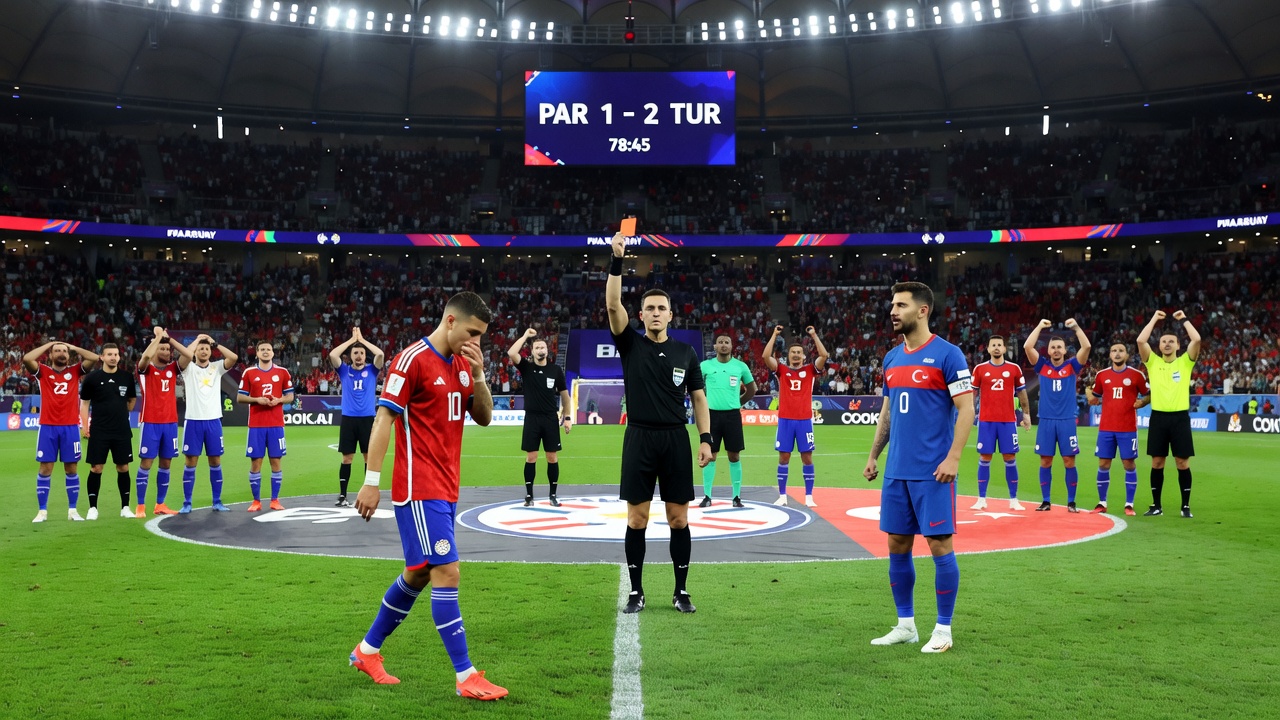
Miguel Almirón became the first high-profile casualty of FIFA's new mouth-covering law on Saturday, dismissed with a straight red card during Paraguay's pivotal 2026 World Cup group stage clash against Türkiye. The Newcastle United winger raised his hand to his mouth while exchanging words with Türkiye defender Mert Müldür, and referee enforcement was immediate. The dismissal left Paraguay with ten men at the worst possible moment, deepening the stakes in a match already carrying enormous consequences for their qualification hopes.
The rule, which FIFA introduced ahead of the tournament, prohibits players from concealing speech directed at opponents or officials - an attempt to eliminate hidden verbal abuse that referees cannot lip-read or assess. Its origins lie in a string of incidents across European competition, most notably a Champions League tie between Benfica and Real Madrid in which Benfica's Gianluca Prestianni covered his face while speaking during the match. Prestianni was subsequently suspended for the second leg against Madrid, and the case became a catalyst for FIFA to codify the behaviour as a red-card offence at international level. The governing body's intent is clear: if a player feels the need to conceal what they are saying, the assumption is that what they are saying should not be said. Debates around fairness in sport often involve data and precedent across disciplines - much as analysts track itf sharm el sheikh women doubles statistics to understand patterns of performance and officiating consistency - and FIFA's decision to act on observable patterns of concealed abuse follows a similar evidence-based logic, however contentious the outcome.
Almirón's dismissal was not the product of sustained provocation or a violent act. He raised his hand instinctively, a gesture common in football for decades, and the card arrived before the dust had settled. The Paraguayan appeared visibly shaken as he walked off the pitch - a veteran of the national team setup, a player who has consistently been one of his country's most dangerous attacking outlets, and now a man watching his World Cup continue from the stands. Paraguay, already in a high-pressure group stage environment where results carry terminal weight, must now reorganise and absorb for the remainder of this fixture and potentially beyond, depending on how suspensions are applied.
A Rule Born From Frustration, Applied Without Mercy
The controversy surrounding the mouth-covering regulation did not begin on Saturday. It has been simmering since FIFA confirmed its enforcement parameters ahead of the tournament. Supporters of the rule argue it is a necessary step: hidden verbal abuse, particularly racially motivated insults, has long been a problem that technology and lip-reading alone cannot reliably address. If players know a covered mouth draws an automatic red card, the theory goes, they will simply stop doing it.
Critics, however, contend that the rule is too blunt an instrument. Football is a game of emotion and confrontation. Players exchange words constantly. The act of covering a mouth during a tense moment does not automatically signal abuse - it can just as plausibly indicate a player trying to avoid his words being picked up by pitch-side microphones, or simply an instinctive gesture under pressure. The Almirón case, whether or not anything remotely abusive was said, will be cited by those who believe FIFA has introduced a regulation so broad that its application is almost guaranteed to produce injustice at some point. Saturday may be that point.
Paraguay's Group Stage Outlook Darkens
For Paraguay specifically, the human cost of the decision is immediate. Almirón has been a central figure in their attacking play, a technically sharp and energetic winger with the ability to create from wide areas and press effectively without the ball. Losing him for the remainder of this match fundamentally alters their tactical shape, forces their manager into an unplanned reorganisation, and hands Türkiye a significant numerical advantage in a fixture that was already finely balanced.
Whether the red card stands beyond Saturday - and whether Almirón faces additional suspension for subsequent group games - will depend on how the relevant FIFA disciplinary committee interprets the offence. A straight red card for this type of infringement typically carries a minimum one-match ban, though the governing body will have discretion depending on context and any review process. For a nation whose World Cup participation has been hard-fought through South American qualification, the timing could scarcely be more damaging.
The Wider Debate FIFA Has Now Ignited
Beyond the result and beyond Almirón, Saturday's incident has immediately intensified the broader conversation about how football is governed at its highest level. Pundits and supporters across social media and broadcast platforms reacted with a mixture of disbelief and concern - not necessarily because anyone is defending concealed abuse, but because the mechanism of punishment feels disproportionate and dangerously open to misapplication.
FIFA will argue the rule is working as intended: a deterrent that carries real consequence. The counterargument is already being made loudly: that in the most important football competition on the planet, a World Cup group stage match has been fundamentally altered by a red card issued not for violence, not for sustained abuse, not for any outcome that could be independently verified - but for raising a hand to a mouth. The governing body has drawn a clear line. Whether the football world accepts it as fair is a different question entirely, and Saturday has ensured that question will not be going away any time soon.