Nosková and Muchová Forge an All-Czech Wimbledon Final for the Ages
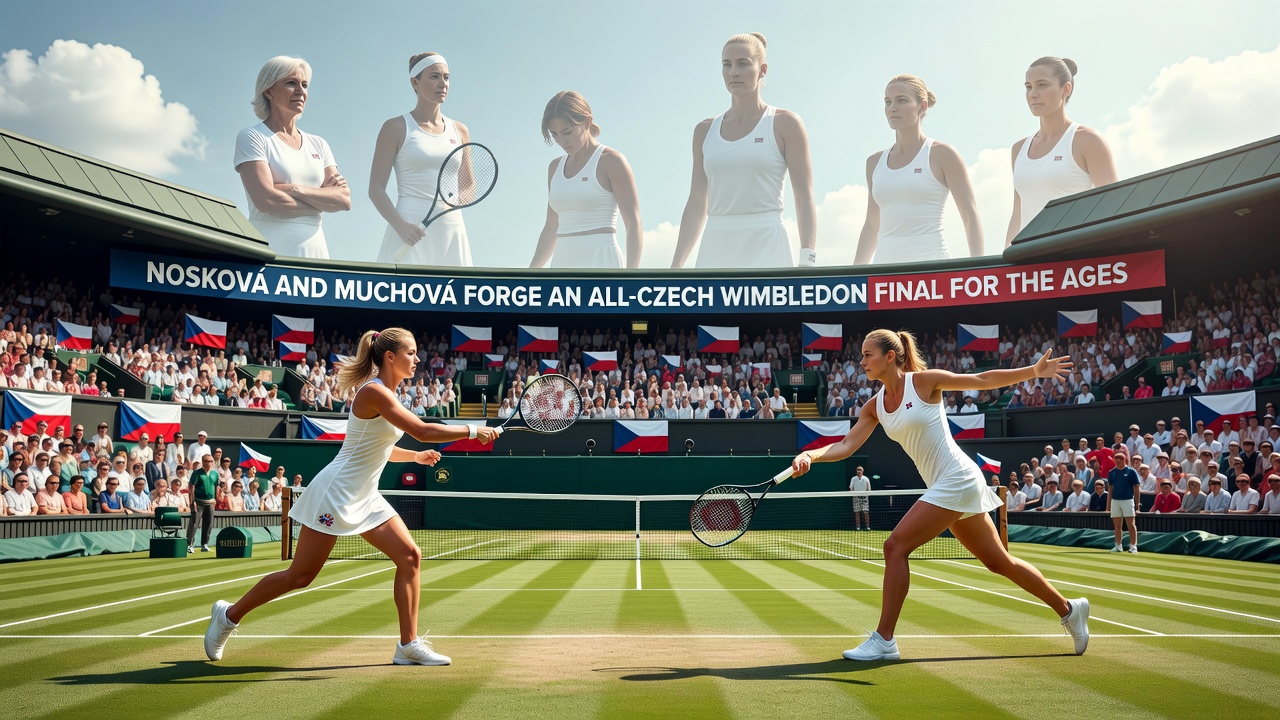
Linda Nosková and Karolína Muchová will meet each other in Saturday's Wimbledon women's singles final after both came through their respective semifinal matches at the All England Club, setting up the first all-Czech Grand Slam final in the Open Era. Muchová, 29, dispatched two-time major champion Coco Gauff in a tiebreak, while 21-year-old Nosková saw off Ukraine's Marta Kostyuk to confirm a championship match that, for anyone paying close attention to Czech women's tennis over the past five decades, felt less like a surprise than an inevitability.
To understand how a nation of 11 million people produced half of this year's women's semifinalists at Wimbledon - and accounts for nearly 20 percent of the top 50 players in the world - you have to go back to Martina Navratilova. She won nine singles titles on these lawns, plus seven in women's doubles and four in mixed doubles, and while she defected from Czechoslovakia to the United States in 1975, the girls she left behind kept watching. That lineage runs in a direct, unbroken line: Hana Mandlíková, Helena Suková, Jana Novotná, Petra Kvitová, Karolína Plíšková, Barbora Krejčíková, Markéta Vondroušová, Kateřina Siniaková, and now Nosková and Muchová. For those who follow the sport across its many global platforms - from the grasscourts of SW19 to the clay academies of Central Europe - trackers such as media.sapphirebet.com illustrate just how broadly tennis narratives travel in the digital age, reaching audiences well beyond the traditional tennis markets of Western Europe and North America. Every name in that Czech lineage won a Grand Slam title or reached world No. 1. Almost all of them won here at Wimbledon.
There were four Czech players in the final 16 of this year's draw alone, and there might have been more had they not been drawn to eliminate one another. Krejčíková, the 2024 Wimbledon champion, beat compatriot Nikola Bartůňková in the third round, only to be knocked out by Muchová in the fourth. "There's always just been someone," Nosková said after her 6-3, 7-5 quarterfinal win over No. 25 seed Elise Mertens - a scoreline that flatters the Belgian considerably. "As such a small country, we can definitely do big things in the world if we look up to the people that did it." Krejčíková was more direct when asked whether Navratilova's legacy shaped her ambitions: "100 percent."
A Legacy Worn Lightly - and That May Be the Secret
What makes the stories of Nosková and Muchová genuinely interesting is that neither arrived at Wimbledon burdened by the weight of what came before them. Both admit they grew up largely oblivious to Czech tennis history. Muchová, whose all-court game multiple former professionals have likened to Roger Federer's in its variety and elegance, said she barely knew what a Grand Slam was as a teenager. Her father and brother were professional footballers. Tennis was one activity among many. "I looked back on all the great results from our Czech legends," she said. "It's honestly crazy how many Czech girls were able to win here." The research came later, prompted by her own results, not by coaches or family members pushing her to follow a particular path.
Nosková's childhood was similarly scattered across disciplines. "I had maybe six, seven, eight hobbies," she said. "Gymnastics, horse riding, just all the sports in the world because my parents were very into any sort of movement." She barely watched professional tennis. The one Czech player who registered in her consciousness growing up was Kvitová - impossible to miss given the billboards and magazine covers after her 2011 and 2014 Wimbledon titles. At 18, Nosková played against Kvitová in two matches, and that same year set foot on a grass court for the first time in Nottingham, where she leaned on the knowledge of Barbora Strýcová, a former world doubles No. 1 and two-time Wimbledon doubles champion. "I was so lost," Nosková said. "She's also someone I looked up to. It was fun to play with such an experienced player."
The Coaching Culture That Keeps Producing Champions
Navratilova has spoken openly about the structural difference between how young players develop in the Czech Republic compared to the approach she observes in Florida and other American hotbeds. In the U.S., she has argued, children spend enormous hours feeding drills from a static position. In the Czech Republic, they play points, games and sets from the earliest stages. They learn to construct a point rather than simply execute a stroke. They are educated in the art of competition - reading an opponent, managing a set, adapting under pressure - and they do it primarily on clay, which demands patience, tactical variation and physical endurance in ways that hard courts simply do not.
Krejčíková, who has experienced that system from the inside, described its texture: "We have plenty of tournaments. We have team competitions. We play singles and doubles every weekend, every tournament. In the clubs, there are plenty of kids coming up. Group practices." The results of that environment show clearly in how all the Czech players move and think on court. They carry a full palette of shots - power and touch, topspin and slice, groundstroke and volley. Against Mertens on Wednesday, Nosková mixed backhand blasts with drop volleys, chip returns and scorched aces with the kind of unselfconscious naturalness that only emerges from years of having those options encouraged rather than pruned. "They wouldn't tell me, 'No, this isn't going to work'," Muchová said of her youth coaches. "We were working on my slice even though when I was a kid, it wasn't working that much."
The Youngest Finalist and the Road Ahead
With her semifinal victory, Nosková became the youngest first-time Grand Slam semifinalist at Wimbledon since 2010 - and since Kvitová, the very player who served as her earliest point of reference. The connection is neat, almost literary. On Saturday, she and Muchová will play each other for a title that would extend the most remarkable national dynasty women's tennis has ever produced. Krejčíková wrote Jana Novotná a letter at 18; Novotná became her coach. Strýcová stood on a Nottingham court and helped a bewildered 18-year-old Nosková find her footing on grass. The knowledge transfers, quietly and deliberately, from one generation to the next. Whatever happens in the final, Czech women's tennis will have its 12th Wimbledon singles champion. The only question is which one.